
File name: animation-cnc-workflow-integration.jpg
Introduction
In the animation and VFX industry, turning digital assets into high-quality physical models is essential but challenging. Creators face tight deadlines, budgets, and frustrating gaps between digital design and physical result, often due to unfamiliarity with manufacturing processes. This leads to poor choices in methods, tolerances, or partners, causing cost overruns and delays. This article provides a clear decision-making framework to bridge this gap, helping teams perfectly realize designs while controlling budget and timeline.
In Visual Content Creation, When Should You Choose CNC Machining Over 3D Printing?
The Advantages and Limitations of 3D Printing for Prototyping
3D printing, or additive manufacturing, excels at materializing complex digital designs. Its greatest strengths lie in creating highly intricate internal geometries, monolithic structures, and enabling rapid design iterations. This makes it the ideal technology for initial concept validation and producing detailed, static display pieces. However, creators must be aware of its inherent limitations. Parts often lack the material strength and durability required for functional mechanisms. The surface finish typically exhibits visible layer lines, requiring significant post-processing for cosmetic applications, and achieving consistency across a batch of parts can be challenging.
Key Scenarios Where CNC Machining Services Are Essential
For projects demanding engineering-grade performance and finish, CNC machining services (subtractive manufacturing) are indispensable. This process is superior for creating robust, precise, and visually flawless physical components.
l Ensuring Mechanical Integrity and Precision Fit
CNC is critical for parts requiring high structural strength, durability, and precise motion. This includes components like joints for stop-motion armatures that endure repeated stress, or bearing holes and slide rails that need smooth, accurate movement with tight tolerances for a perfect fit.
l Delivering Superior Surface Quality and Batch Consistency
The technology produces excellent surface finishes, often ready for direct painting, plating, or close-up shots without extensive finishing. Furthermore, for small-batch production of identical, high-precision parts—like interchangeable mechanical components—CNC precision machining ensures every piece meets the same stringent standards. As noted in the Society of Manufacturing Engineers’ guide on “Additive vs. Subtractive Manufacturing,” CNC is often the superior choice for end-use parts needing high-performance materials, tight tolerances, and excellent surface finish.
How to Define Precision Manufacturing Standards for Your Animation Project?
Defining the Core Dimensions of Precision
For animation props, “precision” is quantifiable and critical for seamless assembly and visual fidelity. It is defined by three concrete dimensions that must be specified. Dimensional Tolerances set the permissible size variation; for example, a posable joint’s shaft and hole require specific clearance or interference fits. Geometric Tolerances control the shape (flatness, straightness) and position (concentricity, perpendicularity) of features to ensure parts align perfectly. Finally, Surface Roughness (Ra Value) dictates the microscopic texture, where a close-up prop may need a near-mirror finish (Ra < 0.8μm), while a weathered piece requires a different profile.
Implementing and Ensuring Precision Standards
Clearly defined standards are only effective when properly communicated and verified during manufacturing. This two-part approach is essential for success.
l The Imperative of Clear Technical Communication
Vague requests like “needs high precision” lead to misinterpretation. Effective collaboration requires clear specification in technical drawings or agreements using universal language, such as stating a “critical bearing hole tolerance H7, surface roughness Ra 1.6.” This eliminates ambiguity and aligns expectations with the manufacturing partner from the outset.
l Partnering with Certified Suppliers for Reliability
To ensure standards are consistently met, partnering with a certified cnc machining parts supplier is prudent. Suppliers with certifications like IATF 16949 (automotive) or AS9100D (aerospace) operate under mature, documented quality management systems. This systemic rigor is a strong indicator of their capability to reliably deliver precision cnc machining services that meet exacting specifications, turning defined standards into tangible, high-quality parts.
What Capabilities Should You Prioritize When Seeking the Best Online CNC Service?
When evaluating a CNC machining parts supplier amidst numerous vendors claiming to offer online machining, a core capability checklist is essential for filtering reliable partners. First, assess their technical manufacturing capability: does the supplier operate multi-axis CNC machining centers capable of handling the complex, organic shapes common in animation designs, and is their material library comprehensive? Secondly, examine their formalized quality systems: are they ISO 9001 certified, and do they have experience with or certification to more stringent standards like AS9100, which indicates a robust quality culture?
Another critical aspect is their digital workflow and support: as a best online CNC service, can they provide instant online quoting, professional DFM (Design for Manufacturability) feedback, and transparent project tracking, as this directly impacts collaboration efficiency and ease. Finally, consider their industry experience and responsiveness: do they have a portfolio or case studies demonstrating experience with custom machined parts for creative or prototype applications, and is their communication proactive and clear? Platforms like Thomasnet offer valuable frameworks for this evaluation, as detailed in their guide how to select a CNC machining supplier.
How to Effectively Control Cost and Delivery Time for Small-Batch Custom Machined Parts?
Animation projects often require custom machined parts in “high-mix, low-volume” quantities. Understanding cost composition is the prerequisite for optimization.
Deconstructing the Cost of Custom Parts
The cost for produces is not just material. It primarily consists of: Fixed setup costs programming, fixture preparation, Material cost, Machine run-time, and Post-processing (finishing, assembly). For very low volumes, the fixed setup cost is a significant portion of the unit price.
Strategic Levers for Cost and Time Optimization
l Design for Manufacturability (DFM):
The single most impactful factor. Simplifying geometries, standardizing hole sizes, and avoiding deep pockets with small tools drastically reduce machining time and cost. Proactively seeking DFM feedback is crucial.
l Material and Process Selection:
Specifying the correct, but not over-engineered, material grade can yield savings. Furthermore, choosing the most efficient primary process (e.g., 3-axis vs. 5-axis machining) for the geometry is key.
The Value of an Integrated Manufacturing Partner
Partnering with a supplier that offers integrated precision CNC machining services can streamline the entire process. Companies like JS Precision leverage efficient process planning and production scheduling to amortize fixed costs effectively. This allows them to offer competitive pricing and reliable lead times, often in the 1-2 week range, for produces orders common in animation studios. Their expertise in optimizing the CNC machining process for efficiency is a direct benefit to clients managing tight budgets and schedules.
From Digital File to Entity Part: What Does an Efficient Collaboration Process Look Like?
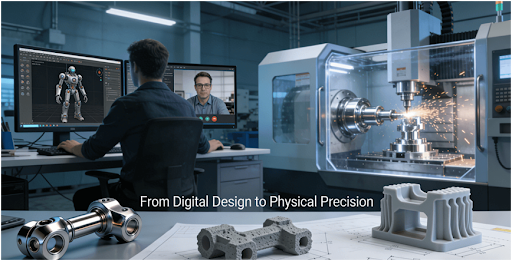
A smooth workflow ensures the lossless transfer of creative intent from the digital animation hub to the machine shop floor. An ideal, modern collaboration process unfolds as follows: it begins with file preparation and submission, which involves exporting a clean, manufacturable 3D model (e.g., STEP, IGES format) with noted critical dimensions and tolerances, and uploading it to the supplier’s secure portal.
Next, clarification through visual context is key; efficient visual content sharing using annotated screenshots, rendered views, or short video clips to highlight cosmetic surfaces and mating interfaces prevents misunderstandings and ensures the manufacturer grasps the full design intent. Finally, the stage of transparent execution and delivery commences, where upon order confirmation, the supplier provides DFM analysis and a schedule, with the best partners offering progress updates or in-process photos, culminating in the delivery of finished, inspected parts ready for integration.
Conclusion
Fusing the boundless creativity of digital animation with the micron-level precision of manufacturing is key to producing high-quality physical models and components. By understanding process applicability, defining quantifiable quality requirements, screening partners with a professional checklist, and optimizing collaboration, animation teams can significantly enhance prototyping efficiency, control budgets, and ensure the final product faithfully matches the on-screen vision.
Does your next animation project require custom machined parts that combine visual impact with mechanical reliability? Get an instant quote today and let a professional manufacturing partner transform your screen-based designs into tangible, high-precision reality.
Author Bio
The author is an industrial consultant specializing in the intersection of advanced manufacturing technology and the creative industries. With over a decade of experience, they are dedicated to helping designers, animation studios, and engineers translate complex digital concepts into producible physical solutions, particularly excelling at optimizing product development processes within budget and time constraints.
FAQ Section
Q: What is the typical lead time for manufacturing parts for animation projects?
A: For typical low-volume custom parts, the lead time from drawing confirmation to shipment is usually within 1 to 2 weeks, depending on design complexity and current scheduling. Choosing a service provider that offers online instant quoting and DFM feedback can significantly shorten the pre-production phase.
Q: Can you handle model files exported from 3D animation software (like Maya, Blender)?
A: Yes. Mainstream 3D animation software can export universal formats such as STEP, IGES, or STL. Manufacturers will perform manufacturability analysis based on these files and provide optimization suggestions to ensure the model retains design details while meeting the process requirements of CNC machining services.
Q: For animation models requiring moving joints, which process is most suitable?
A: For moving joints (like bearing seats, hinges) that demand high precision, strength, and wear resistance, precision CNC machining services are the best choice. They guarantee strict tolerances and smooth mating surfaces, ensuring smooth, durable movement far superior to 3D-printed parts.
Q: How can you ensure parts have a perfect surface finish even under close-up shots?
A: This requires comprehensive control. First, the CNC machining center itself provides an excellent base surface. Second, based on the final visual effect (matte, gloss, metallic), select appropriate post-processing like sandblasting, polishing, anodizing, or plating. Clearly stating surface finish requirements during quoting is key.
Q: If I only need one prototype, is CNC machining too expensive?
A: Not necessarily. For structurally simple or moderately complex single prototypes, 3D printing might be more economical. However, for complex structures, high-strength requirements, or prototypes needing to test real material performance (e.g., metal), CNC machining services hold the advantage. Many online service providers offer optimized solutions for single prototypes, making their cost competitive.
