
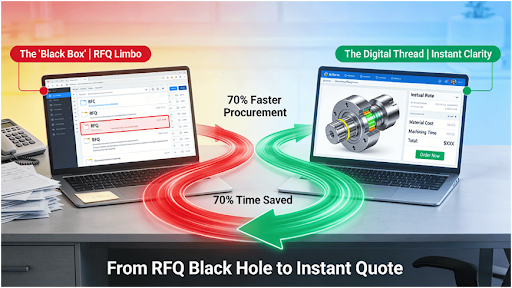
l File name: online-cnc-turning-instant-quote-vs-traditional-rfq-process-comparison.jpg
Introduction
In traditional manufacturing procurement, engineers and buyers are often trapped in a “waiting game.” After sending design files to multiple suppliers, they face days or even weeks of silence, only to receive opaque quotes that are difficult to compare. This murky “black box” process delays project starts, obscures cost control, and typically extends the procurement cycle by 2-3 weeks on average. The core issue is a digital disconnect in the supply chain. Quoting, pricing, and communication rely heavily on manual effort, emails, and phone calls, resulting in painfully slow, non-standardized information flow and a lack of a unified, data-driven, visual collaboration interface.
This article provides a dynamic, visual breakdown of how online CNC turning services transform the traditional “black box” into a real-time, transparent, and predictable digital thread. From design file upload to instant quote generation, and from digital twin analysis to production status tracking, you will see how each step visually compresses time and eliminates uncertainty. Let’s visually dissect the journey from “idea” to “part” through the following key scenarios.
Why Are Static Quotes and Email Ping-Pong Killing Your Project Timeline? (A Visual Comparison)
This section contrasts the disjointed, slow traditional procurement process with the streamlined, automated online workflow, visually highlighting how eliminating non-value-added steps creates dramatic time savings.
l The Traditional “Request for Quote” Black Hole: Visualize the traditional process as a flowchart riddled with red “stop” signs. It begins with sending CAD files via email. Days pass in silence — the first “waiting” stage. Follow-up calls or emails finally trigger a back-and-forth to clarify specifications. Another round of waiting ensues for a revised quote. This manual, sequential communication creates a procurement timeline that is primarily filled with idle time, miscommunication risks, and administrative overhead, not value-added engineering or production.
l The Online “Digital Thread” Alternative: Now, visualize the online alternative as a smooth, green, continuous flow. A designer simply uploads or drags-and-drops a 3D file into a web portal. The system instantly parses the geometry, automatically identifies features, and matches the design against a material and process database. Within minutes, a detailed, interactive quote is generated and displayed. This process eliminates the “waiting” and “clarification loop” stages entirely, compressing what took weeks into hours or even minutes.
l Quantifying the 70% Time Savings: The time saved is not magic; it’s the elimination of non-value-added activities. In the traditional model, over 70% of the pre-production timeline is consumed by manual handling, waiting for responses, and clarifying ambiguities. The online model automates these steps. This dramatic efficiency gain aligns with the core principles of supply chain optimization, such as those outlined in frameworks like the APICS SCOR model, which emphasize streamlining processes and eliminating waste to enhance supply chain responsiveness.
What Really Happens in the “Black Box” Between Your CAD Upload and an Instant Quote?
This section visually demystifies the “instant quote engine,” illustrating the sophisticated steps of automated geometry analysis, material matching, and intelligent process planning that occur in seconds behind a simple upload.
1. Automated Geometry Intelligence and Feature Recognition
The moment a file is uploaded, the system’s “brain” activates. It performs a 3D geometry analysis, automatically recognizing and classifying features: identifying turned diameters, faced surfaces, grooves, threads, and holes. This isn’t just reading a file; it’s understanding the part in manufacturing terms. This step visually highlights different features on the model, translating CAD data into a manufacturing bill of features.
2. Dynamic Material Matching and Real-Time Costing
Next, the system cross-references the part’s bounding volume and material selection against a live material database. It calculates the exact amount of stock required, factoring in standard bar sizes for optimal yield. Simultaneously, it references current material market rates to calculate a precise, up-to-the-minute material cost. This removes guesswork and lag from commodity price fluctuations.
3. Intelligent, Knowledge-Based Process Simulation
This is the core of the “instant” quote. Drawing from a vast manufacturing knowledge base built from thousands of past projects, the system simulates the optimal machining process. It selects the appropriate tools, calculates cutting paths, and estimates machining times for each operation (facing, turning, drilling). The result is not a guess, but a digital pre-production simulation. To understand the technology behind this fully digitized workflow, a deeper look at online CNC turning services and their underlying logic is valuable.
How Does “Pricing Transparency” Visually Build Trust and Prevent Budget Overruns?
This section uses the concept of an interactive, layered quote to demonstrate how cost transparency empowers buyers, builds trust, and allows for informed, value-optimized decision-making.
1. The “Layered” Quote: From Total Cost to Cost Drivers
Imagine an interactive quote that starts with a total price. Clicking on it “explodes” the view into its first layer: Material Cost, Machining Time Cost, and Setup Cost. Clicking on “Machining Time” further breaks it down into time estimates for roughing, finishing, and any secondary operations. This granular cost visibility acts like an X-ray, showing exactly what you are paying for, unlike a single, mysterious line item.
2. Empowering Value Engineering in Real-Time
This transparency enables immediate value engineering. The quote interface can allow you to toggle options. For example, you can visually see how changing a surface finish from anodizing to powder coating affects the total cost. You can evaluate the cost impact of tightening a tolerance from ±0.1mm to ±0.05mm. This transforms the quote from a static price into a collaborative budgeting and optimization tool, preventing surprises and enabling smarter trade-offs.
3. The Foundation of Trust: No Hidden Fees
A transparent, itemized quote is the antithesis of the dreaded “low-ball quote” that balloons with change orders. It builds trust by demonstrating commercial integrity from the outset. It shows that the supplier has nothing to hide and that their pricing is based on a rational, repeatable process. Achieving this level of predictable, decomposed pricing is rooted in the highly automated and disciplined operating system of a precision CNC turning services factory.
From Quote to Delivery: Can You Really “See” Your Parts Being Made?
This section introduces the concept of a “visual production dashboard,” showing how real-time order tracking — from scheduling to final inspection — replaces uncertainty with predictability and control.
- The Digital Dashboard: Your Virtual Factory Window: Upon order confirmation, you gain access to a real-time production dashboard. This isn’t just a status page saying “In Progress.” It’s a visual management tool. The order status moves through clear, defined stages: “Scheduled,” “In Machining,” “Quality Inspection,” and “Ready for Shipment.” This dashboard provides a virtual window into the workshop, transforming the post-order phase from a black hole into a predictable, monitored process.
- Visualizing Quality Assurance: The most critical stage for assurance is “Quality Inspection.” Here, the dashboard can provide tangible evidence. For example, it might display a thumbnail of the first-article inspection report or a summary of key CMM-measured dimensions against their tolerances. In facilities adhering to stringent standards like IATF 16949, this data is not just collected; it is digitally linked to your order, forming a visual and auditable quality record that you can access at any time.
- The Psychological Benefit of Predictability: This visibility provides immense psychological and practical value. It eliminates the need for frantic “where’s my order?” emails. It allows for precise planning of subsequent project steps (assembly, testing). The elimination of uncertainty is a key component of what enables truly fast turnaround CNC turning, as it builds the confidence to proceed with downstream activities based on reliable, visual timelines.
What Should You Look for in an “Animated” Supply Chain Partner?
This section provides a framework for evaluating potential partners by comparing their digital and physical capabilities to a well-animated system, ensuring both the user experience and the underlying manufacturing rigor are excellent.
1. The “Rendering Engine”: Sophisticated Digital Front-End
Evaluate the user interface and automation. Is the quoting process truly instant and insightful, providing automated DFM feedback? Is the order dashboard intuitive and informative? A powerful digital front-end — the “rendering engine” — indicates a partner who has invested in creating a seamless, user-centric experience. This is your first point of contact and a strong indicator of their operational modernity.
2. The “Physics Engine”: Robust Back-End Manufacturing
The slickest interface is worthless without substance. The “physics engine” is the partner’s real manufacturing capability. This includes their machine park (types of CNC lathes, live tooling capabilities), their in-house engineering expertise, and their quality management systems (like ISO 9001). These ensure the digital promise can be physically fulfilled with precision and consistency.
3. The “Animation Quality”: Seamless Integration and Output
The final test is integration and output quality. Does the digital thread seamlessly connect the quote, to the order, to production tracking, to final documentation? Is the quality of the delivered parts — both physically and in their supporting digital packet (reports, certifications) — consistently high? A partner that excels here delivers not just parts, but a reliable, end-to-end service experience where the digital and physical worlds are perfectly aligned.
Conclusion
The future of manufacturing procurement is increasingly a seamless digital experience. By embracing online CNC turning services, companies gain far more than a faster quote. They gain a collaborative system that makes design intent, cost drivers, production progress, and quality data fully visual, interactive, and predictable. This is not merely an efficiency upgrade; it is a fundamental transformation in risk management and supply chain collaboration, replacing opacity with partnership and uncertainty with control.
FAQs
Q: How accurate can an instant online quote really be without human review?
A: High accuracy is achieved by integrating a robust manufacturing knowledge base with your design’s geometry. The system analyzes material volume, feature complexity, and tolerances against historical data from thousands of projects. For standard parts, it’s extremely accurate. For highly complex designs, it provides a reliable baseline, with engineers available for immediate consultation to refine it.
Q: What file formats work best for getting a clear and accurate instant quote?
A: For the most reliable analysis, upload 3D CAD files in STEP or IGES format. These preserve precise geometry. The system can also process 2D drawings (PDF) and mesh files (STL), but a 3D model enables the most comprehensive automated DFM feedback and cost calculation.
Q: How fast is “fast turnaround” typically with online services?
A: “Fast” encompasses the entire process. With instant quoting, order placement takes minutes, not days. Production lead times then depend on complexity: simple turned parts can ship in 1-3 days, while complex components may take 5-7 days. The key advantage is eliminating the upfront quoting delay, providing a predictable timeline from the start.
Q: How is quality assured when ordering online without visiting the factory?
A: Quality is system-driven. Reputable online services are backed by factories with certifications like ISO 9001, which mandate documented processes. You receive digital inspection reports (with photos/CMM data). The transparency of the online process itself is an indicator of a disciplined, traceable manufacturing system.
Q: Can I get design advice (DFM) through an online system, or is it just for ordering?
A: Yes, automated DFM analysis is a core feature. Upon upload, the system will visually highlight potential manufacturability issues (e.g., thin walls) and suggest optimizations. For complex projects, you can then directly consult with manufacturing engineers through the platform, turning it into a collaborative design review tool.
Author Bio
This article is based on cutting-edge practices in digital manufacturing and supply chain visualization. By integrating an advanced online platform with physical precision machining capabilities, LS Manufacturing provides clients with a fully visual, end-to-end solution — from instant, transparent quoting to reliable delivery. Upload your 3D file now to experience a “zero-wait, fully transparent” instant quote simulation and receive a complimentary digital manufacturability analysis report.
